Actual exhibit / Surface & direction
Packaging into
scratching surfaces
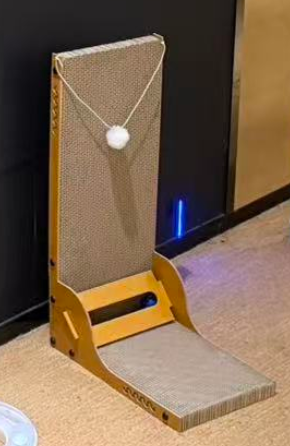
I cut and fixed the corrugated strips, joined the two surfaces, and added a hanging ball, drawing on existing scratching-board designs.
Materials & making ↗Everyday materials. Shared making.
Cat toys and spaces, made from things we already had.
I initiated, prepared, and organized a community exhibition, turning unused materials from home into cat toys. Children passing by joined the making, and nearby residents helped us bring the display together.
My roleConcept, preparation, making, collaborative decisions & curation
Together withChildren who joined the making and residents who helped set up
01 / Observation & preparation
I have always liked cats, and looking for another use for something others are ready to discard.
Because my mother is allergic to cats, we could not keep one at home. I spent time with cats at friends’ homes and volunteered at a stray-cat rescue, cleaning enclosures, changing litter, and feeding the cats. These encounters gave me opportunities to notice how cats play, scratch, and explore.
Some of their toys used simple materials and structures, yet could offer opportunities for play and interaction. Soft clothing, the space inside a box, and the shape of an unused part began to suggest possibilities of their own.
I looked into ways to adapt materials and drew on existing toy designs. Before the exhibition, I prepared multiple ideas, worked out their making steps, and gathered materials to bring to the site.
02 / Changing conditions, shared making
During preparation on site, cleaners mistook a small portion of my materials for waste and removed it. Some plans lost materials they depended on. I continued with the plans that were still possible and tried other uses for what remained, without deliberately buying replacement materials to recreate the original plan.
As I worked, children passing by asked what I was doing. When they heard I was making toys for cats, they became excited and asked to join. Some told me about their own cats.
I invited them to think with me about what the available materials could become. We discussed ideas, made pieces together, and added their drawings. Their curiosity and experiences with cats became part of the preparation, which gradually grew into a shared activity.
03 / The exhibition
I arranged the exhibition with children and nearby residents, using stands, seating, the floor, and the walls so that objects of different sizes and shapes could be seen.
As residents looked around, I explained what the materials had been and why I had chosen them for a new use. The scratching board, for example, used old corrugated packaging that I had cut into strips and secured side by side to form horizontal and vertical scratching surfaces.
I explained the two scratching directions and moved the track’s ball by hand to demonstrate its path. Children helped introduce the exhibition’s theme. I encouraged visitors to think about boxes, old clothes, and other unused things at home as starting points for their own ideas.
The exhibition lasted three hours. Making, arranging, demonstrating, and talking with visitors let me share the observations and material choices behind the objects.
Actual exhibit / Surface & direction
I cut and fixed the corrugated strips, joined the two surfaces, and added a hanging ball, drawing on existing scratching-board designs.
Materials & making ↗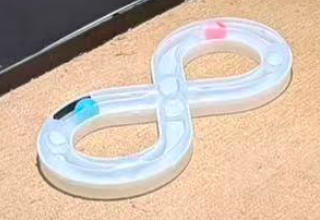
Actual exhibit / Movement & access
I connected unused toy-track sections into a double loop, keeping openings for a cat to reach the ball.
Materials & making ↗Both pieces were completed before the material loss. Their intended interactions informed my explanations at the exhibition.
Browse the full object collection ↗04 / What I learned
I have long enjoyed finding possibilities in things others are ready to throw away. This exhibition made that interest more concrete.
I could turn my observations of cats into objects. I could also open up the materials and making methods to other people, allowing their experiences to influence the designs.
What mattered to me was that finding a new use became something we could take part in together.
05 / Thinking about value
Looking back at the exhibition, I see different needs behind the same toy, and different ways a future offering might respond.
The designs aim to offer scratching, exploring, and chasing. Their usefulness depends on how a cat actually engages with them.
Playing together or making something for a cat can give an owner a way to express care and draw on what they know about their animal.
The children’s eagerness to join, share experiences, and decorate showed me the appeal of taking part in the making itself.
That participation made me consider two possible directions: offering finished toys, or helping other cat owners make their own. Ordinary materials can have useful qualities, but their reuse story alone is not a reason to choose a product.
| Possible offering | A reason to choose it | The tradeoff |
|---|---|---|
| A finished toyFor someone who wants the object ready to use | A completed object, without having to make it themselves. | Usefulness, workmanship, and suitability for their cat would matter. Reused materials do not establish those qualities on their own. |
| A shared making activityFor cat-owning young adults and families interested in making | Materials, guidance, creative decisions, and conversation. Owners could bring observations of their own cats; the organizer could offer general behaviour references and practical support. | Participants give their time. Compared with buying a toy or making one at home, the activity must offer help they value. Someone with materials, methods, and a preference for working alone may not need it. |
The exhibition gives me a reason to explore participation. It does not yet establish which offering would be more commercially viable.
What would it take?
When materials went missing, some of my original plans could no longer be made as intended. That experience points to a practical condition: the old materials available would shape which designs I could offer.
Collecting, sorting, and preparing materials would take effort, even when the materials cost nothing. Adapting pieces to individual cats would also take making and guidance time. A continuing offering would need to account for suitability and those inputs, alongside the price of materials.
What does the experience show?
The children’s interest was visible. Cats’ responses were harder to understand: a resident brought a cat in a carrier, but it was already frightened inside and uncomfortable with the setting. We could not meaningfully observe its toy preferences.
How a cat uses a toy at home, why an owner chooses a product, and whether someone would pay for a making activity remain separate questions. Enthusiasm for making cannot answer all three.
A pop-up could be a setting for display, sales, or shared making. Suitable materials might come from regular collections, future supply partnerships, or unused items participants bring following guidance. Owners could later share how their cats respond at home, informing changes to the designs and guidance.
These possibilities return to the same question: how can familiar materials become useful objects and offer a meaningful experience for people who want to take part?
06 / The object collection
Cat toys, a house, a resting pad, and climbing concepts. Each entry records the materials, making decisions, intended use, and contributions behind the photographed work.
The groups below organize this catalogue, rather than reconstructing the exhibition’s layout. Intended uses remain distinct from cats’ observed responses.
Different ways to put familiar materials into motion, give them a new surface, or invite interaction.
Designed around three familiar cat behaviours: stretching against an upright surface, scratching at ground level, and batting a hanging object.
I used old corrugated packaging for the scratching surfaces, spare rigid pieces or frames for support, and a ball that was no longer in use. The cardboard supplied texture; the base and side supports held the arrangement together.
Drawing on my observations of cats and online examples of upright and flat scratching boards with hanging toys, I cut the cardboard into strips of similar width. I fixed them side by side into two scratching surfaces, joined the horizontal and vertical sections, and added the hanging ball.
I completed this piece before some of the materials were removed. At the exhibition, I explained their earlier uses and how the two surfaces offered different scratching directions.
A double-loop layout intended to keep a moving ball within reach, so a cat can continue following and batting it.
I had noticed cats continuing to watch and reach for balls they had set in motion. Online examples of enclosed tracks helped me consider two features together: edges to contain the ball and openings through which a cat could reach it.
I used plastic channels or track sections left from an unused toy at home, together with an existing ball. I arranged the sections into a double loop, connected them, and retained openings for batting the ball.
I made the track before some materials were removed. During the exhibition, I moved the ball by hand to demonstrate its path and explain the intended interaction.
Round targets intended to be tossed or rolled along the ground for a cat to chase and paw at.
I cut circles from discarded stiff cardboard from home, covered them with fabric from unused clothing, secured the covering, and trimmed the edges. I handled the main construction; children contributed the heart and smiling-face drawings.
The discs were intended to be tossed or rolled along the ground for a cat to chase and paw at. The children's drawings gave their own expression a place on the objects we displayed.
Long, soft forms intended for a cat to hold, kick against, or bat with its paws.
Old clothing supplied both the outer fabric and the scraps inside. I did most of the cutting, filling, and tying, wrapping the scraps into long forms and securing both ends.
The elongated form was intended for a cat to hold, kick against, or bat. Alongside the resting pad and knotted teaser, it shows how filling, flattening, or connecting strips can give old clothing different purposes.
A person holds one end and moves or drags the strips, inviting a cat to follow and paw at them.
I cut old clothing into strips and joined them with knots, carrying out most of the making. The material stayed long and flexible instead of being gathered around a filling.
Someone would hold one end and move or drag the trailing strips for a cat to chase and paw at. This offers a different treatment of clothing from the filled kicker toys or the resting pad.
Simple play props intended for batting, rolling, or moving around, with drawings contributed by children.
I collected cardboard cores left after toilet paper had been used up. Their cylindrical shape suggested batting and rolling; arranged together, they could also become objects for a cat to move around.
The children drew the surface patterns, bringing their ideas into the display. These play props are separate from the small tube-and-cardboard cat-house accessory, which had no specific play function.
A spare caster attached to a strip, intended to be pulled or moved by a person as a target for chasing and pawing.
The display rack I bought came with casters I did not need. Seeing the unused accessories, I wondered whether one could become part of a cat toy.
I developed the idea and tied a long strip to the caster. A person could pull or move it from the other end, making a target for chasing and pawing. Its original shape, with a simple attachment, suggested a new use.
The caster captures an interest behind the exhibition: noticing what is already available and asking what else it might do.
Clothing and cardboard take on different roles as a covering, a filling, and an enclosed space.
A box intended for a cat to enter, hide in, and stay inside, with a fabric curtain that leaves a way through.
The corrugated box had been used when moving home. The orange fabric came from a school-performance garment I had not worn again because it did not suit my taste. The box could provide an interior space and support; the clothing could provide a flexible covering.
A child familiar with cats suggested a curtain, drawing on their interest in sheltered spaces. I proposed keeping the fabric's top connected and cutting the lower part into hanging strips, so it could screen the opening and still allow passage.
We compared the cloth with the opening and discussed how much it should cover. I kept the box structure, formed the entrance, handled the main cutting and fixing, and taped the fabric's upper edge in place. The child helped cut and arrange the strips.
A small cardboard top supported by cardboard tubes accompanied the cat-house work. It was made as an accessory, without a separate intended function.
A broad pad intended as a place for a cat to lie down, formed by wrapping fabric scraps and tying the four corners.
I used old clothing for the outside and fabric offcuts for the filling, keeping the shape broad and relatively flat. I wrapped the scraps inside and tied the four corners, carrying out most of the making.
The long fabric toys gather scraps into a form tied at two ends; this piece spreads them across a wider surface for lying down. Similar materials can take on different intended roles through the way they are arranged.
Two cardboard structures explore space, with their concept status and limited checks described alongside them.
A displayed concept model of a climbing route. Attachment and load capacity remain unverified.
I proposed a climbing use, chose the cardboard's positions, and attached the pieces to the wall with strong adhesive. Children drew the surface patterns.
The model makes the proposed route visible. Its attachment and load capacity remain unverified. A cat landing on it would place demands on the joints and fixing method; those would need investigation before it could become a usable climbing installation.
A rear staircase and top platform, with drawings and a cooling proposal contributed by children. Checked informally with objects; cooling untested.
I began with a rear staircase leading toward a top platform. Children extended that idea by suggesting a cooling function at the front, and two children drew the front-facing patterns.
I handled the more complex construction and joined the cardboard boxes with strong adhesive. The photographs mainly show the decorated front; the climbing steps are at the back.
I put objects on the top platform and used that informal check to judge that it could support a small cat. It did not establish a measured load capacity or performance under a jumping cat. The children's cooling idea remained unexplored; no cooling effect was demonstrated.